Tax guides
Your commute and work costs: flat rate or actual receipts?
How Switzerland's work-expense deductions actually work: commuting (and why you usually deduct the train, not the car), the lunch deduction, and the flat rate vs. itemising. With Zurich and Aargau figures.
Updated on 27.07.2026 · 5 min read
Three deductions are open to almost every employee in Switzerland: the commute, lunch when you can't get home, and a flat rate covering everything else. The commute is normally calculated on the price of public transport, and the cap depends on where you live: CHF 5'200 in Zurich, CHF 7'000 in Aargau, CHF 3'300 for direct federal tax (guide figures for tax year 2025). Lunch is worth CHF 15 per working day, up to about CHF 3'200 a year. Everything else comes to roughly 3 % of net salary, with a floor near CHF 2'000 and a ceiling near CHF 4'000, and you produce no receipts for it at all. Two assumptions cost people money every year: that the car is deductible, and that keeping receipts pays off.
The tax office chips in for the cost of showing up
Nothing gets paid out here. Work expenses come off your salary before the tax is calculated, so you're taxed on a smaller income, and what you actually save is the tax rate applied to the amount you deducted. An employee has three of them: getting there, eating out when going home at midday isn't realistic, and everything else as a flat rate. They sit in the same section of the return and they reach almost every employed person in the country. The flat rate needs no proof. The other two come with conditions attached.
And the conditions on the commute are stricter than most people expect.
The commute: what counts is the train ticket
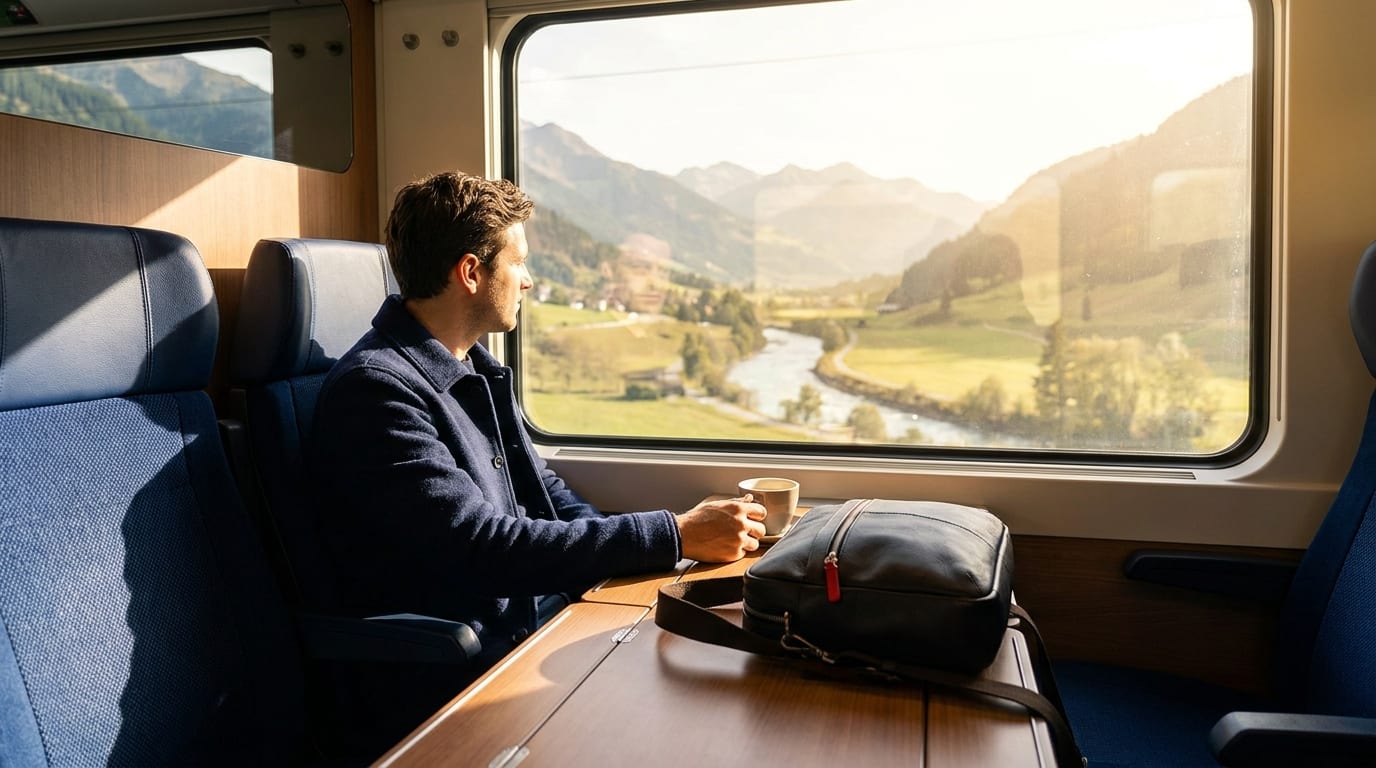
The tax office is a quiet passenger on your commute: it never buys a ticket, but the fare comes off your salary before anyone works out what you owe. By default that fare is the cheapest reasonable public transport for your route, usually your GA or Streckenabo. Not what your car costs you.
Your car, at a guide rate of about CHF 0.70 per kilometre, counts only where using it is genuinely justified:
- there's no reasonable public transport for your route,
- it doesn't run at the hours you start or finish, or
- public transport would cost you a great deal of extra time.
If none of that fits, the deduction stops at the price of the ticket you didn't buy, however many kilometres you actually drove (the same logic that decides how your car shows up elsewhere in your return). Cycle or walk and there's a flat CHF 700 instead. Then comes the ceiling, and that's the one place where Zurich and Aargau clearly part company.
| Maximum commute deduction (tax year 2025, guide figures) | Direct federal tax | Zurich (cantonal) | Aargau (cantonal) |
|---|---|---|---|
| Cap | CHF 3'300 | CHF 5'200 | CHF 7'000 |
So the cantonal and municipal side usually lets you deduct more for the commute than the federal one does, and Aargau is more generous than Zurich.
Worth checking: the caps and the per-kilometre rate are guide figures for 2025 and get reviewed from time to time. What governs your return is the version in force for your canton and your tax year, which your cantonal Wegleitung sets out, and the car-versus-public-transport question turns on your specific route anyway.
The meal deduction when you can't get home
If you genuinely can't get home at midday, the extra cost of eating out is deductible: a flat CHF 15 per working day, up to about CHF 3'200 a year. Where your employer runs a subsidised canteen or contributes to your meals, that halves to roughly CHF 7.50 per day, up to CHF 1'600. Which case applies to you shows on your salary certificate, so there's nothing to estimate.
If you could realistically eat at home, there's no deduction at all. Zurich and Aargau use the same amounts here, so this one doesn't move when you cross a cantonal border.
The flat rate for everything else, and when receipts beat it
For the small costs of working (a workspace at home, tools, specialist literature) you get a choice, and this is where most people overthink it. The flat rate is the no-questions-asked option: about 3 % of net salary, with a floor of roughly CHF 2'000 and a ceiling of roughly CHF 4'000. No receipts, no justification.
Itemising is the alternative. It only pays when your documented costs clearly beat the flat rate, which for a typical employee they rarely do. Unless you have something substantial, a genuine dedicated home office for instance, the flat rate wins and the shoebox of receipts isn't worth the evening it takes to sort. The cheap way to settle it is to add the receipts up once and hold the total against 3 % of your net salary. If the receipts lose, the flat rate goes in and the box can go. Whether itemising works out better in your case depends on your circumstances.
What Lara's year adds up to
Lara has a net salary of CHF 80'000, commutes into Zurich on a train pass costing CHF 3'400 a year, and eats lunch out because she can't get home midday (no canteen).
- Commute: CHF 3'400, the cost of her pass, comfortably under the Zurich cap.
- Meals: CHF 3'200, the full flat amount.
- Other expenses (flat rate): 3 % of CHF 80'000 is CHF 2'400, inside the CHF 2'000 to CHF 4'000 band, claimed without a single receipt.
That's about CHF 9'000 of work expenses. At a marginal tax rate of roughly 25 %, it takes around CHF 2'250 off her tax bill.
The figures here are guide amounts for 2025, so your own result moves with your canton, your municipality, your income and the limits in force for the year.
Three questions and the numbers fall out
How you get to work, how far it is, what the pass costs: from those three answers TaxWize works out the commute deduction with your cantonal cap already applied, checks whether a car commute is justified in your case, and holds the flat rate against your actual costs so the bigger number is the one that lands in your return. For the three deductions every employee in Switzerland has, that's the whole job.
Frequently asked questions
- Can I deduct my car for the commute to work?
- Usually not. What you deduct is normally the cost of public transport. A car counts only if using it is justified, for example there is no reasonable public transport, it does not run at your working hours, or it would cost you a lot of extra time. When justified, the rate is around CHF 0.70 per kilometre up to your cantonal cap. Otherwise the deduction is limited to the cheapest public-transport equivalent.
- What is the flat-rate deduction for other professional expenses?
- Around 3 % of net salary, with a floor of about CHF 2'000 and a ceiling of about CHF 4'000 (guide figures for 2025, worth verifying). Every employee gets it for general work costs without producing a single receipt. You only itemise actual costs if they genuinely exceed the flat rate.
- How much can I deduct for lunch at work?
- A flat CHF 15 per working day, up to about CHF 3'200 a year, provided you genuinely cannot get home for the midday meal and there is no subsidised canteen. If your employer subsidises meals or runs a canteen, it is halved to roughly CHF 7.50 per day, up to CHF 1'600. If you could eat at home, there is no deduction.
Related guides
Keep your deductions in view
TaxWize reads your documents, surfaces deductions that may be relevant, and prepares your tax return for filing. CHF 39 per tax return per tax year.
Explore TaxWize